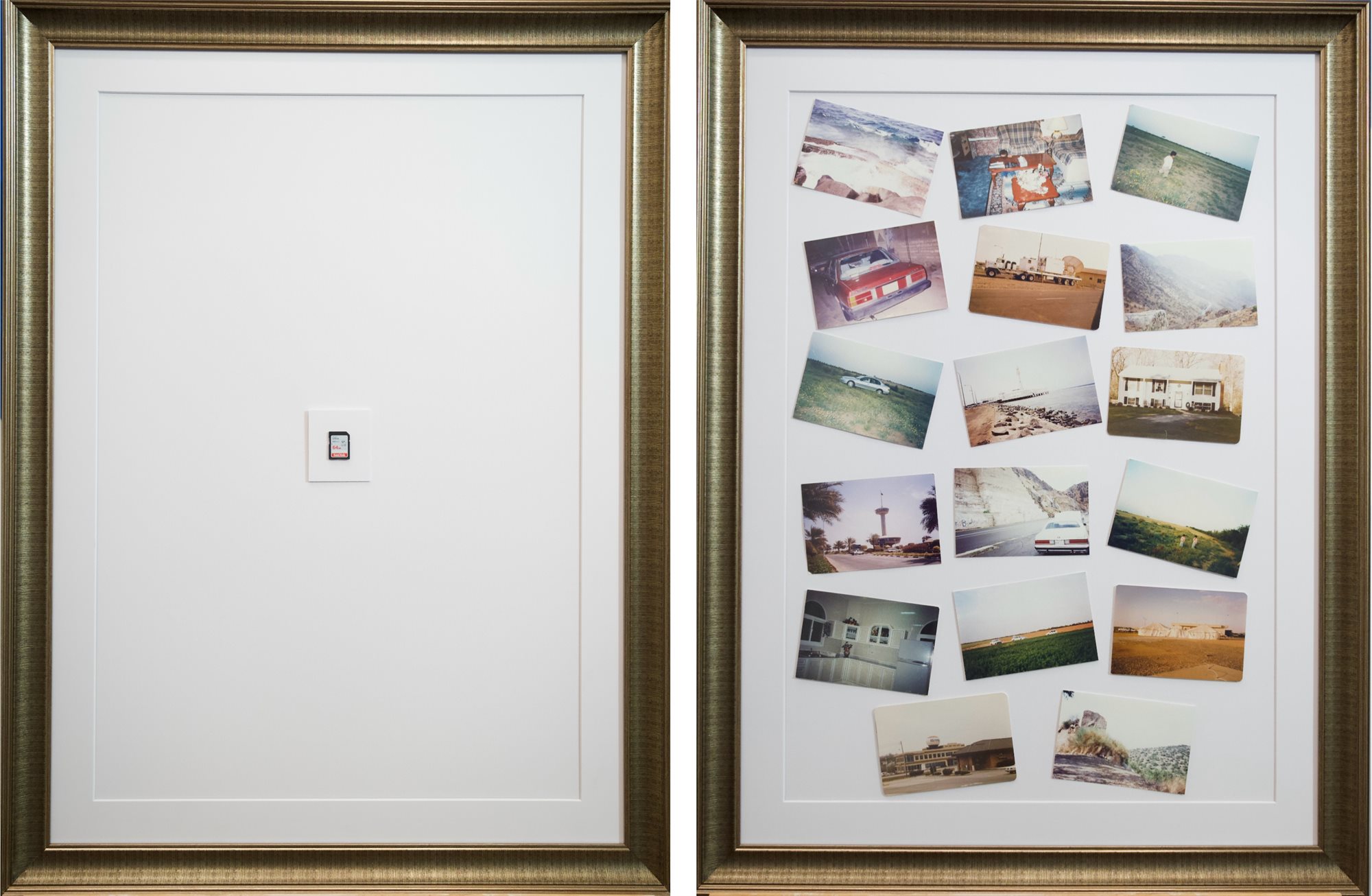
The work is formed of two frames. One holds film photographs taken by my father in the 1990s and early 2000s. They exist as physical images, shaped by light and age. Faces are absent, allowing the images to remain open, unclaimed, and shared.
The second frame presents a digital memory card. Small in scale, expansive in capacity. It reflects a present where images are collected quickly and stored densely, separated from touch and physical presence.
The work does not look backward with nostalgia, nor forward with critique. It simply marks a shift, from photographs as objects we lived with to images that exist primarily as data. Thakerah is an observation of this quiet transition, and how memory continues to adapt to the way it is held.